Tim Horrigan's Nascar Qualifying Page

Copyright © 2005-2007 by Tim Horrigan

I originally put this page together in 2005, when two new wrinkles were added to the Cup qualifying process. (This was also the year that the Chase for the Championship was introduced.)


The Nascar universe is always evolving and never moves in a strictly linear fashion (although they do always drive counterclockwise.) In 2005 the qualifying system (for all races other than the Daytona 500) changed. Click here to read the official Nascar explanation.

The first of these was the "impound system", which was not very popular and last year (2007) was used in only 5 out of 36 races. Under this system, cars are impounded after the qualifying time trials, and no work can be done on them until just before the green flag. Since teams can't switch setups after qualifying, they were forced to use a race setup for qualifying (and/or try to tweak the car during pit stops.) It was used in a majority of races the first year in 2005, but this was rolled back the next year. Rumor has it the deciding factor was complaints from NBC Sports, who wanted footage of mechanics tinkering with the cars during the pre-game show.


The second innovation introduced in 2005 was the Top 35 system, which has been very popular— although maybe it became less popular when a number of competitive new teams repeatedly had trouble snagging one of the seven or eight remaining slots in the 43-car fields. There has always been some provision for getting top teams who happen to qualify poorly into the main event. Nascar used to use something called "provisionals" (and still uses them in the lower-level series.) The provisional system was absurdly complicated, and often favored part-time "field filler" teams over the serious competitors. Under the new system, the top 35 teams in the owners point standings are guaranteed a spot in the field.

The number 35 was chosen because in 2005, there were approximately three dozen full-time teams. Since then the number of teams has increased significantly, especially since Toyota joined the Cup circuit. In 2007, 48 teams entered every race during the first half of the season, and even the part-time teams were much more competitive than in the past. There is talk of reducing the number of guaranteed spots to 25 in the future, which would be roughly half the number of serious full-time teams— or even of just eliminating guaranteed spots altogether ad simply letting the 43 fastest qualifier races.

During the first five weeks of the season, the previous season's owners points are used. After Week 6 the current year's points are used.

Owners points are similar to drivers points, only they accrue to the car rather than the driver, and teams get points just for qualifying. The car's identity is somewhat synonymous with its car number, except that teams frequently swap car numbers, which gets very confusing at times. (In 2008, for example, Penske Racing swapped the identities of its #2 car and the #77 car, because the #77 car only made two starts last year whereas the #2 car was driven by Kurt Busch, who has past champion's provisionals to fall back on if needed. And just to make things more confusing, the #77 car was the #06 car last year. And this #77 has nothing to do with the #77 team for which Dave Blaney and others drove a few years ago: THAT car is now Michael Waltrip's #55 car.)


Normally the points races are virtually indistinguishable, at least at the top of the leader boards. In 2007, there were some high-profile cases, however, where owners and team points are different. For example, the #01 car finished 10th in the owners points race with 3793 points in 36 starts. It smain driver Mark Martin was in 27th place in the drivers points, with 2960 points in 24 starts.

Basically, the Top 35 system works as follows. After the time trials, the remaining Top 35 teams bounce the slower qualifiers out of the field. So, in essence, the non-Top 35 teams have eight spots to compete for. Past champions can use a Past Champion provisional if they need to: this puts them in 43rd place on the starting grid. This provisional is now only available six times per season. In 2007, Dale Jarrett managed to use his allotment up by the 9th event of the season. The most recent eligible champion has priority for this provisional: so, 2004 champ Kurt Busch has priority over Jarrett (1999), Terry Labonte (1996) and Bill Elliott (1988).

The "Top 35" rule applies to the top 35 teams out of whoever actually shows up at the track. If one or more Top 35 teams skip an event, the 36th, 37th, etc. teams would get in. Unless I missed something, the first time this happened was in July 2007, at the Brickyard 400, when the 34th place team, Ginn Racing's #13 team (usually driven by Joe Nemechek), went out of existence after Bobby Ginn sold his Ginn Racing operation to Teresa Earnhardt's Dale Earnhardt Inc. (Ginn also owned the 30th place #14 team but that team merged with DEI's #15 team, which had been out of the Top 35.) The 36th-place #21 team got the last Top 35 provisional.

If the time trials have to be cancelled (which would normally be only because of rain) the procedure after the first month of the season (events #6 through #36) is as follows. Basically, the field is chosen on the basis of owners points, but there are a few exceptions. Rules #2 through #4 would rarely be used, although Brian Vickers actually did use Rule #4 at the 2007 Pepsi 400. It is pretty hard to imagine a scenario where the first half of Rule #6 would come into play—  so essentially these seven rules boil down to the Top 43 teams in owners points getting in, unless a past champion or recent race winner needs a provisional:

#1) - First 35 by current Owner Points [position 1-35] [top 35 teams do NOT need to attempt ALL the races]
#2) - Last Years Cup Champ or the Event Champion if not already in the field
#3) - Car Owners whose team has won in the previous and current season not already in the field
#4) - Drivers who have won in the previous and current season not already in the field
#5) - ALL Past Nextel Cup Champions not in by 1 thru 4 [is NOT charged against the 6 past champ provisionals]
#6) - Qualifying Attempts [not starts] with Owners points as the tie breaker
#7) - Qualifying Order Position
("Post Entry" teams entered after the official deadline would be left out..)


During the first month of the season, when the Top 35 is determined by previous season owners points, the procedure is:

#1) - Previous season Owner Points [position 1-35][top 35 teams do NOT need to attempt ALL the races]
#2) - Race winners from the previous and current season not already in the field
#3) - ALL Past Nextel Cup Champions not in by 1 or 2
#4) - Current season Owner Points [Top 35][not in by rules 1-3]
#5) - Current season race attempts ties broken by current owners points standings [not in by rules 1-4]

Here is the Top 35 which applies for the first month of the 2008 season, based on 2007 owners points:

Rank

Car#

Driver

Owner

2007
Owners
Points

2007
Race
Attempts/
Starts

1

48

Jimmie Johnson

Jeff Gordon

6723

36/36

2

24

Jeff Gordon

Rick Hendrick

6646

36/36

3

07

Clint Bowyer

Richard Childress

6377

36/36

4

17

Matt Kenseth

John Henry

6298

36/36

5

5

Casey Mears

Rick Hendrick

6293

36/36

6

20

Tony Stewart

Joe Gibbs

6242

36/36

7

77 [was 2]

Sam Hornish Jr.

Roger Penske

6231

36/36

8

31

Jeff Burton

Richard Childress

6231

36/36

9

99

Carl Edwards

Georgetta Roush

6222

36/36

10

29

Kevin Harvick

Richard Childress

6199

36/36

11

1

Martin Truex Jr.

Teresa Earnhardt

6164

36/36

12

11

Denny Hamlin

J D Gibbs

6143

36/36

13

12

Ryan Newman

Roger Penske

4046

36/36

14

16

Greg Biffle

Jack Roush

3991

36/36

15

88 [was 25]

Dale Earnhardt Jr.

Mary Hendrick

3949

36/36

16

8

Mark Martin
Aric Almirola

Teresa Earnhardt

3929

36/36

17

01

Regan Smith

Teresa Earnhardt

3793

36/36

18

26

Jamie McMurray

Geoff Smith

3556

36/36

19

43

Bobby Labonte

Richard Petty

3517

36/36

20

9

Kasey Kahne

George Gillett, Jr

3489

36/36

21

42

Juan Pablo Montoya

Floyd Ganassi

3487

36/36

22

18

Kyle Busch

Joe Gibbs

3456

36/36

23

41

Reed Sorenson

Chip Ganassi

3275

36/36

24

6

David Ragan

Mike Dee

3251

36/36

25

96

J.J. Yeley

Jeff Moorad

3203

36/36

26

40

Dario Franchitti

Felix Sabates

3163

36/36

27

19

Elliott Sadler

George Gillett, Jr

3140

36/36

28

7

Robby Gordon

Robby Gordon

3066

36/36

29

15

Paul Menard

Teresa Earnhardt

3037

36/36

30

28 [was 88]

Travis Kvapil

Doug Yates

3005

36/36

31

66

Jeremy Mayfield

Joe Custer

2975

36/36

32

38

David Gilliland

Doug Yates

2924

36/36

33

70

Scott Riggs

Joe Custer

2894

35/36

34

22

Dave Blaney

Bill Davis

2856

33/36

35

45

Kyle Petty

Kyle Petty

2814

36/36


There are at least three past champions racing in 2008 whose teams begin the year out of the Top 35. Kurt Busch is planning to run a fulltime schedule. (Penske Racing swapped his team's points with Cup rookie— and open-wheel veteran— Sam Hornish Jr.'s new team.) Bill Elliott and Dale Jarrett are only planning to run part time. A fourth champion, Terry Labonte lacks a ride but is not retired and did run a few races in 2007. Another past champ, Mark Martin plans to share a Top 35 car, the #8, with other drivers, but he could very conceivably move over to a non-Top 35 car at some point down the road.

One new wrinkle is 2008 is that (except at the Daytona 500) the Top 35 drivers will go first in qualifying. This ensures that the remaining drivers who need to get in "on speed" all run their qualifying laps at the end of the session. This means that those drivers face uniform conditions— and it also eliminates the embarassing situation where an underdog gets the pole early on and then loses it when it starts raining before qualifying can be completed.


The other national series have similar qualifying rules, including the Past Champions provisional for the last spot in the field. The top 35 teams will be guaranteed spots in the 43-car Nationwide Series fields. The top 30 teams will be guaranteed spots in the 36-truck Craftsmen Truck fields.

The new rules were designed to help the lower-ranked full-time Cup teams, who no longer had to worry about running out of provisionals. (This was not a common occurrence, but it did happen to Kyle Petty and Scott Wimmer in 2004.)
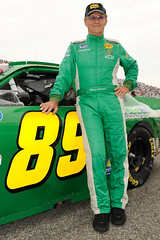
The big losers were the guys the next step down, i.e., the marginal (more or less) professional "field fillers" such as Kirk Shelmerdine and Morgan Shepherd. (Shepherd, by the way, is quite a colorful character. I hope he still gets to make the occasional Cup start. And I will mention, even though this has nothing to do with the subject at hand, that he happens to be Dale Earnhardt Jr.'s uncle.) These drivers typically tried to run roughly half the races on the schedule, owning their own teams and always finishing last and making just enough money to get by. Under the old system, thanks to their accumulated provisionals, the "field fillers" often bumped significantly faster and much better-financed Busch drivers, road course specialists, etc. whose teams were making one-off Cup appearances. Under the new system, the fastest drivers will make the field, even those whose cars are making cameo appearances. The number of full-time teams has increased greatly since the Top 35 rule was introduced: in 2004 there were roughly three dozen serious full-time teams, but in 2007 there are almost four dozen.


Except at Daytona...

I think I figured out how the Daytona 500 qualifying system works. It is almost as complicated as the Tax Code. I will make multiple references to the "top 35": this is the top 35 teams in the previous year's owners' points race. (See above for a more detailed explanation.)

  1. (Positions # 1-2) The first step is the same as at every other event: a 2-lap time trial. (One difference is that the qualifying takes place a week before the 500.) The winner gets the Bud Pole, the runner-up the outside pole. These two drivers are guaranteed a spot in the big race as long as they bother to go through the second phase of the process.

  2. (Positions # 3-39) The Twin 150s (currently the Gatorade Duel 150s, formerly the variously-sponsored.Dual 125s or Twin 125s.) The top 66 qualifiers (and normally there are fewer than 66 teams which show up for qualifying) are assigned to one of two preliminary races, typically held the Thursday before the big race. The Top 35 teams are guaranteed a spot in the main event, no matter what (unless they miss the Duals/Duels altogether.) Spots 3 through 39 are based on Dual finishes. Typically, this means 33 Top-35 teams and 4 other teams get into the main event through this part of the qualifying process (unless one of the two front-row cars is not a Top-35 team.) Seedings for the 500 are based on order of finish in the Dual races. (In 2008, a non-Top 35 team— Michael Waltrip's #55— qualified for the front row alongside defending 2007 champion Jimmie Johnson. Hence, 34 Top 35 teams and 3 other teams moved on to the main event.)

  3. (Positions # 40-42) Next, we go back to the time trial results and pick the three fastest qualifiers not already in the 500. (This means that, going into Duals, the three or four non-Top 35 teams with the fastest qualifying times will always already be locked into the 500 starting grid.)

  4. (Position # 43) Finally, if there is an eligible past Cup series champion who has not yet qualified, he or she gets the 43rd starting position. (For the 2008 event, 2004 champ Kurt Busch has priority over Dale Jarrett [1996] and Bill Ellliott [1988].) (If (as would normally be the case) there is no past champion who can use the "Past Champion Provisional", then the final spot goes to the next-fastest (i.e., fourth-fastest) qualifier not already in the race.

Once the actual race starts, none of this matters much— unless of course your team isn't even in the race at all! It would be interesting to find out what would happen if any of the Top 35 teams failed to finish 66th or above in qualifying. (In 2007, Matt Kenseth and Kasey Kahne recorded qualifying speeds of zero mph, because they got disqualified. But, only 61 cars showed up at all.) It looks as if the rule would be that all Top 35 teams get to go to the Duals, regardless of how badly they do in the time trials— hence, if necessary, the 66th place, etc. cars would get bumped from the Duals to make room for Top-35 cars.

See also:


Or another way to look at the Daytona qualifying

First the pole sitter and the outside pole sitter get spots #1 and #2 and they are locked into those spots. They do have to enter the Gatorade Duels but it doesn't matter how they finish.

Only 66 cars make the Gatorade Duels: 33 in each race. (I believe, although I am only 99.9% sure of this, that the field is made up of the "Top 35" teams based on last year's owners points plus up to 31 other teams, based on qualifying time.) In 2007, 61 cars made qualifying runs. In 2008, only 54 cars did so.

Theoretically, the first Gatorade Duel race, with the odd numbered cars, is infinitesimally stronger than the second one with the even numbered cards. So, one more car gets in from Duel #1, when the next 37 spots are filled: 19 from the first race, 18 from the second. Spots 3 through 39 are filled up according to Duel finishing position.

BUT: any "Top 35 team" which finishes out of the money in the Duels gets to bump non-Top 35 teams out of the race. The net result is that the 4 highest-finishing non-Top 35 teams get into the race via the Duels. (If a non-Top 35 team wins a place on the front row—as happened in 2008, when Michael Waltrip's #55 car finished 2nd in qualifying— then only 3 "transfer" posts are available.)

The 43rd and last place is available for a Past Champions Provisional, should it be needed. In 2008, three past champions entered non-Top 35 cars at Daytona: Kurt Busch, Dale Jarrett and Bill Elliott. (Busch has priority because he won the championship the most recently, in 2004.)

Spots 40 through 42 go to the fastest 3 qualifiers who aren't already in the race. If no Past Champions Provisional is used, the 43rd spot goes to the 4th-fastest qualifier who isn't already in the race.

In 2008, eight non-Top 35 drivers made the race (including Kurt Busch, who used a loophole in the rules.)

  1. Michael Waltrip won the outside pole in the time trials.

  2. Kenny Wallace and Brian Vickers got in from Duel #1. Dale Jarrett (a past champion) and John Andretti got in from Duel #2.

  3. David Reutimann and Joe Nemechek were the two fastest qualifiers out of those who weren't already in the race.

  4. Kurt Busch used a Past Champions provisonal after finishing last in his Duel, and 34th out of 53 qualifiers.

Reutimann finished just a few feet behind Andretti in Duel #2. If he had caught Andretti, Boris Said would have been the 42nd driver on the starting grid. If Busch's team had not swapped points with Sam Hornish's #77 team, (ignoring the fact that several teams would have approached qualifying differently) then Hornish would have knocked Vickers out of the "transfer spot" in Duel #1. Busch would have gotten in as a Top 35 team (and would have started 39th rather than 43rd.) Jarrett and Andretti still get in, as would Reutimann and Nemecheck. Said would still be going home disappointed. And Bill Elliott would have gotten the last spot. (At least I think that's how it would have gone.)

The Daytona 500 field is not reseeded by qualifying time: however, if (as happened to Jeff Gordon in 2007), a driver gets disqualified from the Duels, his or her starting position will be knocked down to 42nd and everyone else moves a notch.

See also:


Useful Links


The Forgotten Liars


Home

The Forgotten Liars

Other Works

Where & What to Buy!

Miscellaneous Stuff

All Hail Dubya!

Contact Info

AutoBio

Amazon.com

Mail
Email