I Led Two Lives!

My Adventures in the SecondLife® virtual world

Copyright © Timothy Horrigan 2006-2008


Timo at His/Her Home


If you want me to refer you for membership in SecondLife, you can log onto:

(You don't actually need a referral to join, but if you sign up as a paying member, my avatar gets a small bonus.)


For More Info see:


One hot day in July 2006, I happened to read a story in the newspaper about an online computer game called Second Life. And, even though I have (with a fair degree of success) tried to avoid getting caught up in gaming, I was curious enough to check it out. And I got caught up.

The game falls into the general category of multi-user role playing games. It is not dissimilar to games like World of Warcraft or The Sims Online, although it is not based on a kid's video game.

There is no real violence in the game: there are weapons and explosives but they don't do much. (One day, I did get shot and killed two or three times, but that just meant that I was teleported to a nearby location. I just went right back where I was and get shot and killed by the same guy again.) There is however, lots of sexuality (albeit cartoonish sexuality.) The sex is limited to the Mature (or R-rated) sections of the game's Grid. (Your avatar's body is neuter, but it can be take either a male or female shape, and you can buy prosthetic sex organs. It is even possible for advanced players to get pregnant. Even without the sex organs, you can do some pretty suggestive stuff, especially in a female body.)

The first step in the game is to choose a name. You can pick any first name you please, so I chose my real-life name, Timothy. (This turned out to be a mistake, for reasons which I will explain in a bit.)

At any given time, you are limited to a list of 100 or so last names (which get rotated periodically, so there are really about a thousand different surnames.) I chose the last one on my list: Zapotocky. Some of the surnames are just plain silly, like "Lollipop." Many are names of philosophers, e.g., "Marx" and "Bergson." Some are references to earlier computer games, like "Frobozz." Some are names of people who developed the program. Many are obscure references: "Zapotocky" appears to be inspired by Antonin Zapotocky, former President and Prime Minister of Czechoslovakia.

The next step is to create an "avatar." This term is familiar from Adidam, but here it just means your bodily form. When I signed up for the game, the standard boy avatars seemed relatively boring (although I have seen some pretty cool male avatars once I started wandering around.) The girl avatars had a lot more personality. I tweaked one of them, and ended up being a pink-haired tart. Even though this may not be the most appropriate identity for me in my usual guise as a rather boring old middle-aged man, it is hard to give up even an inappropriate identity.

Another factor which led me to choose the bodily shape I did is that you spend a lot of time looking at your avatar's butt. The standard camera angle is a sort-of first-person and sort-of second-person shot (a sesqui-person view, as it were) taken from about two metres (or seven feet) behind yourself. So, the game is much more enjoyable if you give yourself a cute butt.

hotel corridor


I suppose I am embodying one of the great fears people have about any type of role-playing on the internet: the sweet young girl who is actually a cynical middle-aged man. I tried not to make my female form too young, but it is difficult to make yourself look too old (though you can get up as high as your early 40s.) My avatar is pretty sweet (most of the time) and she has the most adorable little pigtails. (In most of the pictures on this page, she has bubble-gum pink hair, but since then she switched to a more natural auburn color.)

Teenagers are not allowed on the Second Life grid (although there is a separate Teen Grid) but some players do make themselves very petite, which kind of makes you look childlike. Most players, however, opt to be statuesque and sophisticated.

The majority of the avatars you meet in Second Life are girls: the male-female ratio is about 60%-40%. I suspect that mine is one of many female avatars who are in fact men in real life.

Second Life has more appeal to female players than most games since the gameplay deals a lot with stuff women care about (i.e., relationships, clothes, decorating, money and sex) and not very much with violence and gadgets. (The weapons in Second Life are highly ineffective, and are banned from most public places anyway.) However I am reluctant to believe that a majority of the players are female in real life. (It seems to me, BTW, though I have no hard data on this, that real-life women almost always choose to be women in Second Life whereas men like to swing both ways.)

Although there are many other "gender imps" on the grid, I am more suspicious than most because of my male first name. The cool people tend to accept me, name and all, but of course sometimes I have to deal with uncool people. I eventually created a couple of "alts" (alternate characters) with female names. They both work as dancers in clubs. (Also, I have two other alts who are named after major characters in my unpublished 80s rock and roll novel whose current working title is Follow the Glare. Until the book is finished, they won't have much work to do, though they do go online two or three times a week just to look around and enjoy themselves— which, come to think about it, is basically also what their big sisters do.)

Although we all look young, the music played in the discos and casinos and such tends to be mainstream rock from the late 1970s or early 1980s, which implies (even though this era is now considered campy) that many, perhaps most, of us are in our 30s or higher. (The hipper places tend to play 1990s techno, still implying that many of the DJs and dancers must be over 30.)


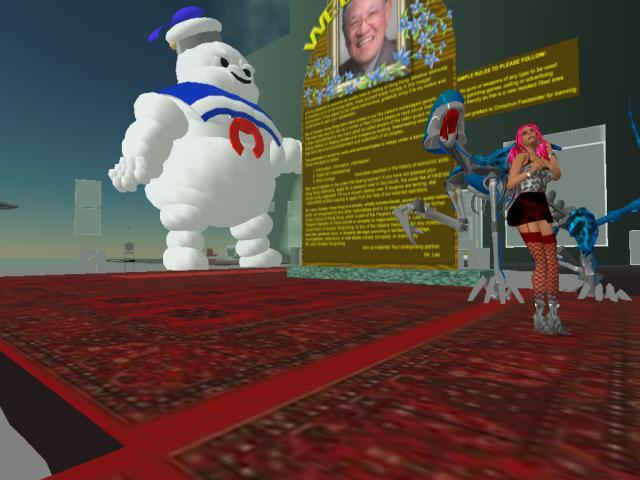
Although the default value for the Grid is ostensibly a PG rating (no sex or nudity allowed), in fact there are only a few PG areas. Ironically, the most decadent place I visited on the Grid was one of the few PG destinations— someplace called Mr. Lee's Casino, where things were constantly exploding and where my character ended up being taken over by a farting animation.

Mr. Lee's
Mr. Lee's Greater Hong Kong: Jiminy (164, 116, 106)


Second Life is a rare case of software getting ahead of the hardware. It has its own client: it doesn't run inside a web browser. (The client may be a precursor of a new generation of 3d browsers: it's about freakin' time for a new generation, I think! The old Netscape model of the mid-1990s has gotten kinda stale, but I digress... ) The client has a very interesting 3d graphics system: it runs slowly but it's still fun to use (and luckily you can move around freely even while waiting for the objects in your immediate environment to download and become visible— or, to use the verb favored by Second Lifers, "to rezz.") The client was also designed from the ground up for 21st century computers, with lots of memory, powerful audio-visual cards, persistent highspeed internet access, etc. My machine, a standard-issue 2005-vintage Apple Mac Mini, represents the minimal platform for SecondLife (though it's pretty damn powerful by most standards): in fact Steve Linden (the Linden in charge of Mac compability issues) ocne told me (or technically told one of my alts) "It's a miracle SL runs at all on your machine."

Until January 2006, the client was proprietary, but it has now been released under a GNU Copyleft license as an open source product.

The servers seem to be severely stressed: even though Second Life crashes gracefully, it still goes down a lot. I worry about about how well the system is going to scale up in the future. Even though there has been a lot of buzz in the press about Second Life, the number of users is not very large. There are roughly 7 million members (as of June 2007.) However only two million or so are "active members" who have logged on within the past 60 days. I would guesstimate that perhaps 200,000 or so of those so-called active members are obsessives like me who log on almost every day. Only 20,000 to 40,000 of us are typically online at a given moment (and we are scattered over a universe which is, if you translate it to real-world terms, roughly the size of Rhode Island.) Finally, the number of paying members who pay a monthly or annual fee is probably less than 100,000.

But even with a small population, the infrastructure is severely strained. Performance degrades significantly if you gather too big a crowd in one place: once you have more than a few dozen avatars gathered together, the screen gets updated only once a twice a second, you start to become very clumsy, people's skin turns grey, you can't read the signs on the wall, the music gets distorted. You feel like you're stoned, which is OK in a disco environment but not so good if you're doing something more serious.

The official limit for the number of avatars in a 256 metre by 256 metre "sim" (basically, a sim is an area corresponding to one of the hundreds of servers on Linden Labs' huge server farm) is "about 100." In practice a sim will usually crash before you can get that many avatars on it. "Crashing the sim" becomes the goal of a party: I have heard more than one announcement like "come on down here, invite all your friends, and let's see if we can crash the sim." It's rather eerie being at a disco when the sim crashes, because you simply cannot stop dancing: the software is supposed to log you out when the sim crashes, but frequently the logout routine goes down when the sim crashes. 


Amsterdam Square: Amsterdam (146,55,29)


Two of the more interesting innovations of Second Life have little to do with the technical infrastructure:

  1. Linden Lab has legitimized the practice of buying and selling the game's currency. It is perfectly legal (as far as Linden Lab is concerned) to buy and sell Linden $ outside the game. (The exchange rate currently fluctuates within a range from roughly 250 to 300 L$ to the US$.) New players start out with 250L$, which is just barely enough to wander around and buy some clothes. Premium subscribers get a sign-up bonus and a small weekly stipend. The Linden Dollar Exchange has turned out to be a fairly efficient micropayment system.

  2. Linden Lab lets players keep the rights to intellectual property created in the game (although I am sure there will be lawsuits over who has what rights.) This is an incentive for entrepreneurs to create their own content for the game.

  3. The basis of the game's economy is similar to that of my home state of New Hampshire: flea markets, arts & crafts, real estate, personal services (including what is euphemistically referred to as "escorting"), entertainment, politics, and (until it got banned) gambling— as well as lots of real-world money from outside the game.


My avatar started out as a homeless floozy who picks up a few Linden bucks on dance pads in sleazy juke joints. Although my avatar is still largely jobless (although I dabble in sexwork, pole-dancing and flea marketing), I have gradually turned into a somewhat respectable citizen. I bought a small lot in a new suburb called "Nari" and I am even a member of the local landowner's council.

I have acquired a few prosthetic sex organs. If you want to go through at least a semblance of courtship, and ask me nice, I would probably be happy to show you. Alternatively, you can hire me as an escort.

I still like to hang out in sleazy juke joints. I now consider myself to be a little too cool to been seen dancing on dance pads (except once in a rare while.)


BabyDollz: Amsterdam 2 (150, 202, 25)

Although I have visited many clubs, and worked in several, my favorite dive is still the now-defunct and always funky "BabyDollz" in the Amsterdam neighborhood. There I have met some very lovely avatars with equally lovely human beings (or "Real Life avatars") behind them. (A big shout out to Tempest Jewel, Suzi Sola, Higgo Drillon, Yuna Gandini, Fyre Raine, the fabulous Chelsea Chandler and all the rest of the crew!). Aside from the great people who hang out there, my second-favorite thing about BabyDollz is that the owner, Stroker Serpentine, is an outstanding virtual architect. Although his BabyDollz space is quite festive and busy, with many nooks and crannies to explore, he doesn't use a lot of bandwidth-wasting gimmicks. Moreover, instead of just plopping his dance floor down in the middle of a huge empty space, Stroker designed BabyDollz so that the actual dance floor is just barely big enough to hold the 60 or so avis needed to crash the sim, and he saves bandwidth by making good use of a few well-chosen textures.

Stroker sold Amsterdam in the summer of 2007 to a Dutch company called 3Dutch.com. In a much-publicized incident, he initially put the sim up for auction on eBay: the winning bid fell through but he fairly soon found another buyer.

He still owns the rest of his "Eros Continent." The buyer of the two Amsterdams was a Dutch media company called BOOM BV. On June 20, a press release was issued where Stroker announced that "I am pleased we found a good company for my Amsterdam baby."

Amsterdam Square
Relay for Life Kiosk; Amsterdam Square

My Second Life sister Tammy Nowotny is involved on a small level with 3Dutch and the new Amsterdam: she rents a small shop there and just recently began dancing and escorting on the legendary "Whore Corner" and at the new Fitzgerald Hotel.

The Babydollz building is still standing, and has been renamed "Club HoneyBeezz." The new owners host parties there fairly frequently. Stroker and his partners also opened an entirely new club called "BabyDollz Exotica" on the Eros Exotica sim which was open for a few months before he decided to get out of the club business.


Tammy Nowotny killing bugs for Kelly Services
Kelly Services is now on Second Life! Click here to learn more!


The Second Life system has applications beyond mere gaming. It could be (and is) used for prototyping products, for training first responders, and as a venue for teleconferences— and for some reason the business world seems especially fascinated with the idea of using it for virtual job fairs. I do wonder about some of the practical issues of using the current Grid for quote-unquote "serious" business applications. Many businesses were for many years reluctant even to allow employees access to the world wide web because of all the "junk" out there. (Some organizations are still offline even today.) The Second Life Grid is a pretty lascivious place: even the relatively serious neighborhoods are rather silly. Even if you set up your own private island, your people will wander off it (and there will sometimes be holes in the security which would allow outsiders to wander on.)

Businesses could probably set up their own separate grids with only serious content allowed, but that would be difficult— and employees would still be able to use the clients on their laptops to connect to the Big Grid. And just about anything can happen on the Big Grid.


Another practical application for Second Life is to use it as a virtual movie soundstage. The resolution is pretty good if you have a fast connection and powerful workstations. The imagery at its best is plenty good enough for streaming video or even for analog television. The avatars' body language is quite expressive, although our faces aren't. (We all have beautiful faces, but our facial expressions usually only run a gamut from bemused to befuddled.) Unlike real actors, you can program SL avatars to hit their marks exactly right every time, which makes it easy to edit different takes together. There are ways to vary the facial expressions, even though it is difficult to do so spontaneously. And the default facial expressions are appropriate if you are doing machinama.


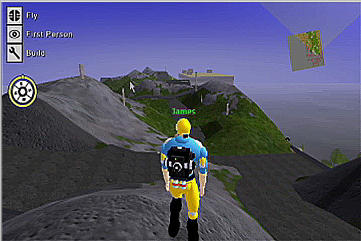
Extra Check out this funny video of the original beta version of Second Life:

If you are interested in being referred by me, log onto:

or email me at:

Please make your request as a brief text or HTML email with as few misspellings as possible. The main thing I need is your email address. And if you just wanna send a hate and/or love note, that's cool too.

(NOTE: Not that spammers are going to pay any attention to this, but please note that this email address was put up there for a very specific purpose, and I think I just made it clear what that purpose is: referring the sender to SecondLife. This purpose has nothing to do with the usual BS which spam is about. The same goes for your email address, should you send it to me. See my Spam Page for more info.)


shopthebunny pet collection


The Forgotten Liars, a novel by Timothy Horrigan